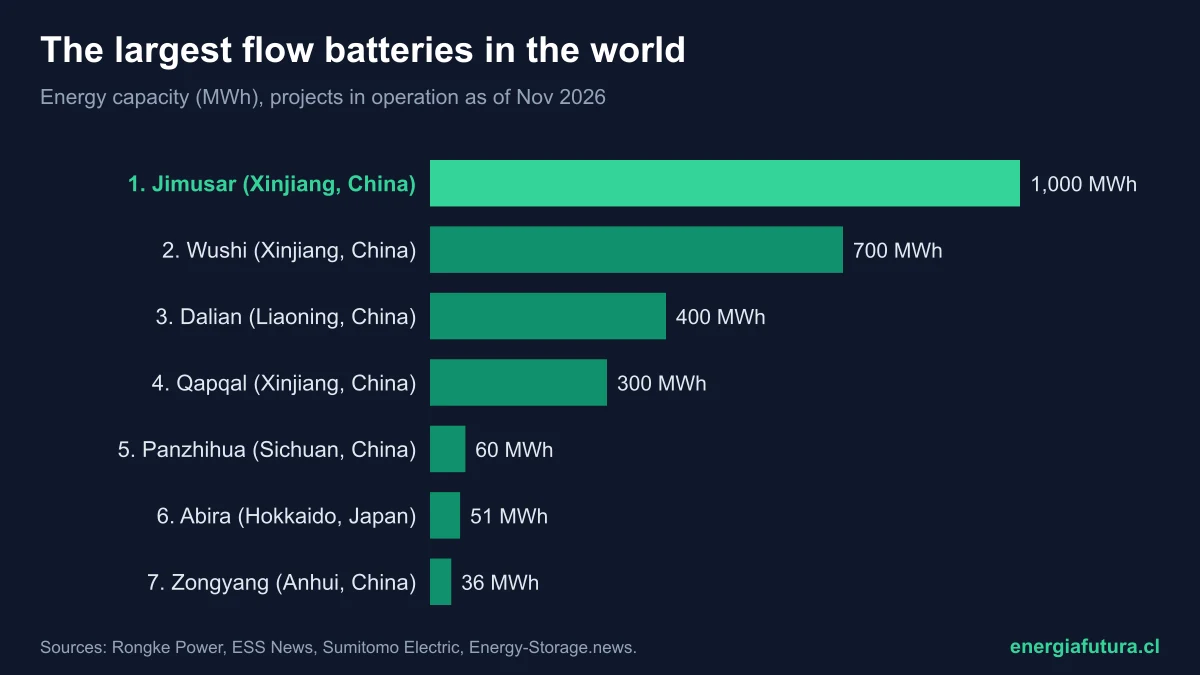
Updated on 7 November 2026. The world's largest flow battery is in Jimusar, in China's Xinjiang region: it has 200 MW of power and 1,000 MWh of energy capacity, with five hours of discharge. It is the first gigawatt-hour-scale vanadium flow battery to enter operation, according to ESS News, and it has run at full capacity since 31 December 2025 with technology from Rongke Power.
It is followed by two other Rongke batteries in China: Wushi, also in Xinjiang, with 175 MW and 700 MWh, and the first phase of Dalian, with 100 MW and 400 MWh. This ranking covers the largest flow batteries in operation, using data from the company that built them or from specialist media; announced or under-construction projects are listed separately. Because China does not publish a single register of these batteries, the list may be incomplete.
View the data as a table
| Energy capacity | 1,000 MWh |
| Power | 200 MW |
| Project investment including the solar plant | US$520 M |
| Associated solar plant | 1 GW |
Ranking of the largest flow batteries in the world
The table ranks projects by energy capacity in megawatt-hours (MWh), the figure that determines how long the battery can supply power. All are vanadium redox flow batteries, the most widespread flow chemistry: in Energía Futura's review we found no operating projects of other flow chemistries at a comparable scale.
| Rank | Project | Location | Power | Energy | Duration | In operation |
|---|---|---|---|---|---|---|
| 1 | Jimusar | Xinjiang, China | 200 MW | 1,000 MWh | 5 h | December 2025 |
| 2 | Wushi (Xinhua) | Xinjiang, China | 175 MW | 700 MWh | 4 h | Late 2024 |
| 3 | Dalian, phase 1 | Liaoning, China | 100 MW | 400 MWh | 4 h | 2022 |
| 4 | Qapqal (CECEP) | Xinjiang, China | 75 MW | 300 MWh | 4 h | June 2024 |
| 5 | Panzhihua (SPIC) | Sichuan, China | 12 MW | 60 MWh | 5 h | June 2025 |
| 6 | Abira, Hokkaido | Japan | 17 MW | 51 MWh | 3 h | April 2022 |
| 7 | Zongyang (Conch) | Anhui, China | 6 MW | 36 MWh | 6 h | December 2022 |
Sources: Rongke Power, ESS News and Sumitomo Electric, Energía Futura review as of 7 November 2026. Duration is energy divided by power. Rongke presents the Dalian station as 200 MW and 800 MWh in two equal phases but gives no commissioning date for the second, so the ranking counts only the first.
| Jimusar | Xinjiang, China | 200 | 1,000 | 5 | 2025 |
| Wushi (Xinhua) | Xinjiang, China | 175 | 700 | 4 | 2024 |
| Dalian, phase 1 | Liaoning, China | 100 | 400 | 4 | 2022 |
| Qapqal (CECEP) | Xinjiang, China | 75 | 300 | 4 | 2024 |
| Panzhihua (SPIC) | Sichuan, China | 12 | 60 | 5 | 2025 |
| Abira (Hokkaido) | Hokkaido, Japan | 17 | 51 | 3 | 2022 |
| Zongyang (Conch) | Anhui, China | 6 | 36 | 6 | 2022 |
| Woniushi | Liaoning, China | 5 | 10 | 2 | 2012 |
Jimusar: inside the largest flow battery in the world
The Jimusar battery is part of a 1 GW solar and storage project covering about 1,870 hectares in the county of the same name, with an investment of CNY 3.8 billion, about US$520 million, according to ESS News. Its developer, according to that outlet, is Huaneng Xinjiang Jimusar Power, part of China Huaneng Group; Rongke Power, which supplied the batteries, lists it on its website as a CTG project. Engineering was handled by PowerChina Northwest Engineering.
Rongke estimates the battery allows about 230 GWh of additional renewable energy to be used each year that would otherwise be lost to curtailment. The full project, with the solar plant, would generate 1.72 TWh a year and avoid more than 1.6 million tonnes of CO2, according to the developer. It is part of China's first demonstration base combining wind, solar, storage and hydrogen.
View the data as a table
| Power (MW) | Energy (MWh) | |
|---|---|---|
| Jimusar | 200 | 1,000 |
| Wushi (Xinhua) | 175 | 700 |
| Dalian, phase 1 | 100 | 400 |
| Qapqal (CECEP) | 75 | 300 |
| Panzhihua (SPIC) | 12 | 60 |
| Abira (Hokkaido) | 17 | 51 |
| Zongyang (Conch) | 6 | 36 |
| Woniushi | 5 | 10 |
Where the biggest flow batteries are
China holds six of the seven largest flow batteries in operation, and three of them are in Xinjiang, the region with the most solar and wind farms in the country. The only one outside China in the ranking is in Abira, on Japan's island of Hokkaido: a 17 MW and 51 MWh system that Sumitomo Electric built for Hokkaido Electric Power's grid to integrate wind power, in operation since April 2022 with an expected life until 2043.
View the data as a table
| Jimusar | In operation | 1,000 MWh |
| Wushi (Xinhua) | In operation | 700 MWh |
| Dalian, phase 1 | In operation | 400 MWh |
| Qapqal (CECEP) | In operation | 300 MWh |
| Panzhihua (SPIC) | In operation | 60 MWh |
| Abira (Hokkaido) | In operation | 51 MWh |
| Zongyang (Conch) | In operation | 36 MWh |
| Woniushi | In operation | 10 MWh |
| Laufenburg (FlexBase) | Under construction | 2,100 MWh |
Japan was a pioneer: in 2015, Sumitomo installed a 15 MW and 60 MWh system at the Minami-Hayakita substation, then the world's largest, according to Energy-Storage.news. Since it was a demonstration, we do not include it in the ranking of operating projects. The size of flow batteries has grown more than 16-fold in ten years.
How the largest flow battery in the world grew
The record changed hands three times in three years. In 2022, the Dalian station became the largest with 400 MWh. In late 2024, Wushi overtook it with 700 MWh, according to ESS News. And in December 2025, Jimusar crossed the 1,000 MWh barrier for the first time. All use batteries from the same company: Rongke Power, based in Dalian.
- 2012Woniushi, 5 MW and 10 MWhNext to a wind farm in Shenyang; Rongke says it keeps 100% of its capacity.
- 2015Hokkaido, 15 MW and 60 MWhSumitomo Electric trial at the Minami-Hayakita substation, the largest of its time.
- April 2022Abira, 17 MW and 51 MWhCommercial, to integrate wind in Hokkaido; to run until 2043.
- 2022Dalian, 100 MW and 400 MWhFirst phase of Rongke's station in downtown Dalian.
- June 2024Qapqal, 75 MW and 300 MWhDedicated to solar integration in Xinjiang.
- December 2024Wushi, 175 MW and 700 MWhRongke completes it and it becomes the world's largest.
- 31 Dec 2025Jimusar, 200 MW and 1,000 MWhFirst gigawatt-hour flow battery in full operation.
- May 2026Laufenburg picks InvinitySwiss project of up to 2,100 MWh, due in 2029.
Does your company work in energy storage? Reach Energía Futura's readers.
See advertising optionsWhy China leads in flow batteries
China has three advantages in this ranking. The first is demand: Xinjiang, home to three of the four largest flow batteries, set out to connect more than 20 GW of new storage to the grid by 2025, according to ESS News, to use solar and wind power otherwise lost for lack of lines. The second is raw material: China produces about three quarters of the world's vanadium.
The third is industry: besides Rongke, a vanadium flow battery manufacturing complex of 1.6 GW a year is being built in Baotou (Inner Mongolia), with an investment of CNY 11.5 billion, about US$1.63 billion, according to ESS News. Rongke also offers the electrolyte on lease, a model it first used in Zongyang (2022) and Panzhihua (2025), where the customer does not buy the vanadium, lowering the upfront investment.
What comes next: projects under construction
The next record could be outside China. In Laufenburg, Switzerland, FlexBase has been building since May 2025 a vanadium flow battery project that would start with up to 1,500 MWh and grow to 2,100 MWh, due in 2029. In May 2026 it chose Britain's Invinity to design the system, according to pv magazine. Power figures have varied between reports.
In China there are at least two other large projects on the way: a 300 MW and 1,200 MWh station in Yongren, Yunnan province, whose construction began in early 2025 according to Vanitec, and the second phase of a hybrid project in Wushi with 250 MW and 1,000 MWh of vanadium flow, according to ESS News. Energía Futura could not confirm whether either has entered operation.
| Project | Location | Power | Energy | Status | Source |
|---|---|---|---|---|---|
| Laufenburg (FlexBase) | Aargau, Switzerland | 800 MW to 1.2 GW by phase | 1,500 to 2,100 MWh | Under construction, due 2029 | pv magazine, May 2026 |
| Yongren | Yunnan, China | 300 MW | 1,200 MWh | Construction began early 2025 | Vanitec, February 2025 |
| Wushi hybrid, phase 2 | Xinjiang, China | 250 MW | 1,000 MWh of flow | Unconfirmed | ESS News |
| Dalian, phase 2 | Liaoning, China | 100 MW | 400 MWh | No date reported | Rongke Power |
Sources as listed in each row. If Laufenburg reaches its target, it would double Jimusar's energy and be the first gigawatt-hour-scale flow battery outside China.
Flow batteries vs lithium batteries
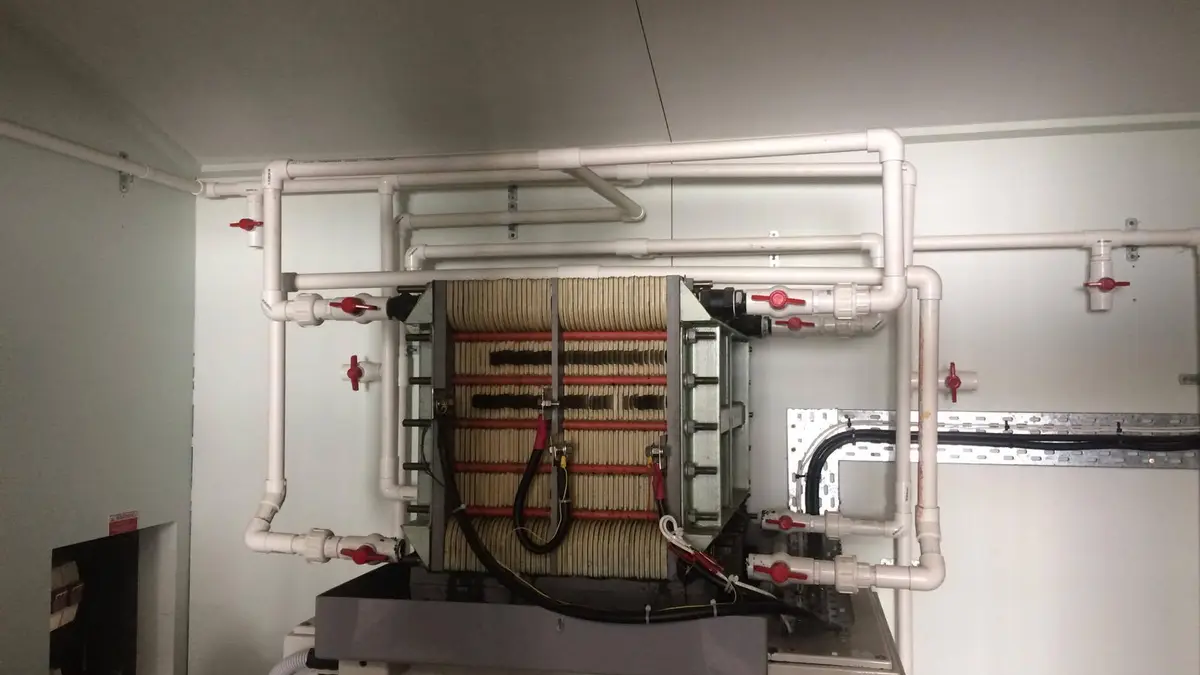
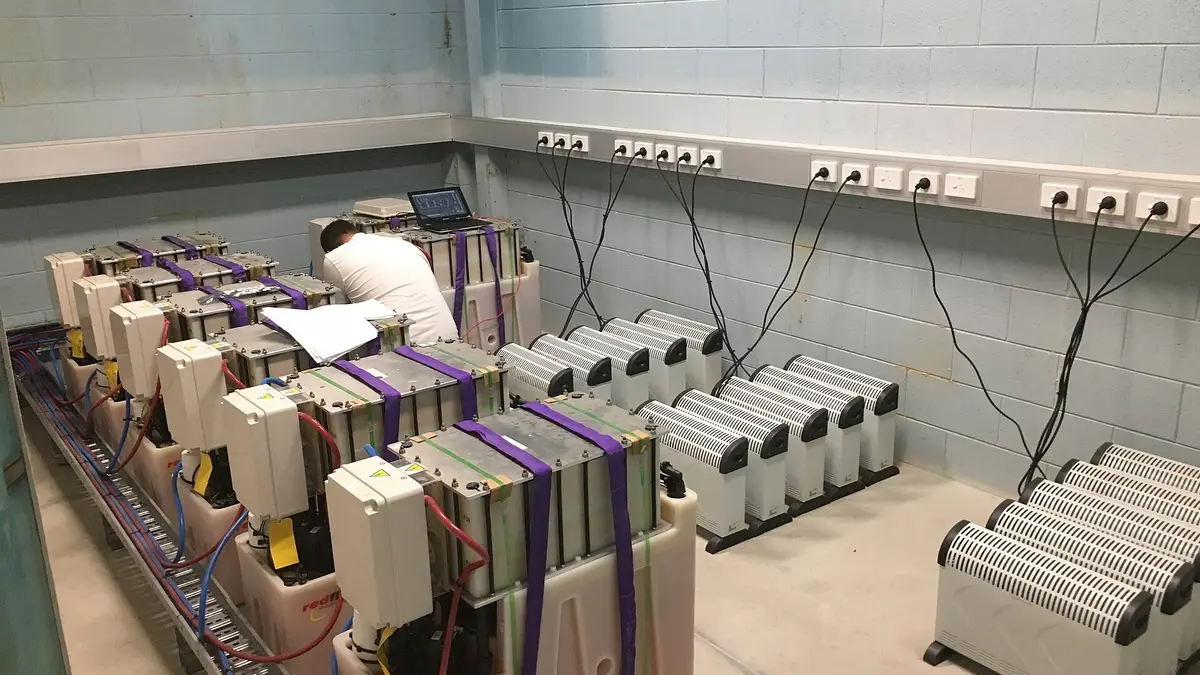
A flow battery stores energy in liquid electrolytes that circulate from two tanks through a cell stack. To store more hours, the tanks just need to be bigger, and vanadium electrolyte does not degrade like lithium: Rongke says its 2012 Woniushi system still keeps 100% of its capacity after more than a decade. The drawbacks are higher upfront cost and the space they take up, which is why for very long storage the main alternative remains pumped hydro, as shown in the largest pumped storage plant in the world.
Even with Jimusar's record, the planet's largest batteries are still lithium, several times bigger, as we showed in the largest battery in the world. The vanadium flow batteries use comes mainly from China, as we reviewed in the largest vanadium producers.
In Chile, grid-connected storage is almost all lithium: the country already has 11.3 GW of batteries in operation, testing and construction, as we reported in storage in Chile. Energía Futura found no public records of large-scale flow batteries operating in the country.
How to cite this data
Energía Futura (2026). “The largest flow battery in the world 2026: ranking of the biggest flow batteries”. Updated on 7 November 2026. energiafutura.cl/en/news/the-largest-flow-battery-in-the-world-2026-ranking-of-the-biggest-flow-batteries. Data: Rongke Power; ESS News; Sumitomo Electric; Energy-Storage.news; pv magazine.
Frequently asked questions
What is the largest flow battery in the world?
The one in Jimusar, Xinjiang (China), with 200 MW and 1,000 MWh, in full operation since 31 December 2025.
Who makes the largest flow batteries?
Rongke Power, from Dalian (China), supplied the four largest in the ranking.
How many hours does a flow battery store?
Those in the ranking store between 3 and 6 hours; Jimusar, 5 hours.
What metal do flow batteries use?
The largest use vanadium dissolved in a liquid electrolyte. Other chemistries, such as zinc-bromine or iron, exist at smaller scale.
How much did the largest flow battery in the world cost?
The Jimusar project, including 1 GW of solar and the 1,000 MWh battery, cost CNY 3.8 billion, about US$520 million, according to ESS News.
Are there large flow batteries outside China?
Yes, in Japan (Abira, 51 MWh). In Switzerland, Laufenburg is under construction, aiming for 2,100 MWh by 2029.