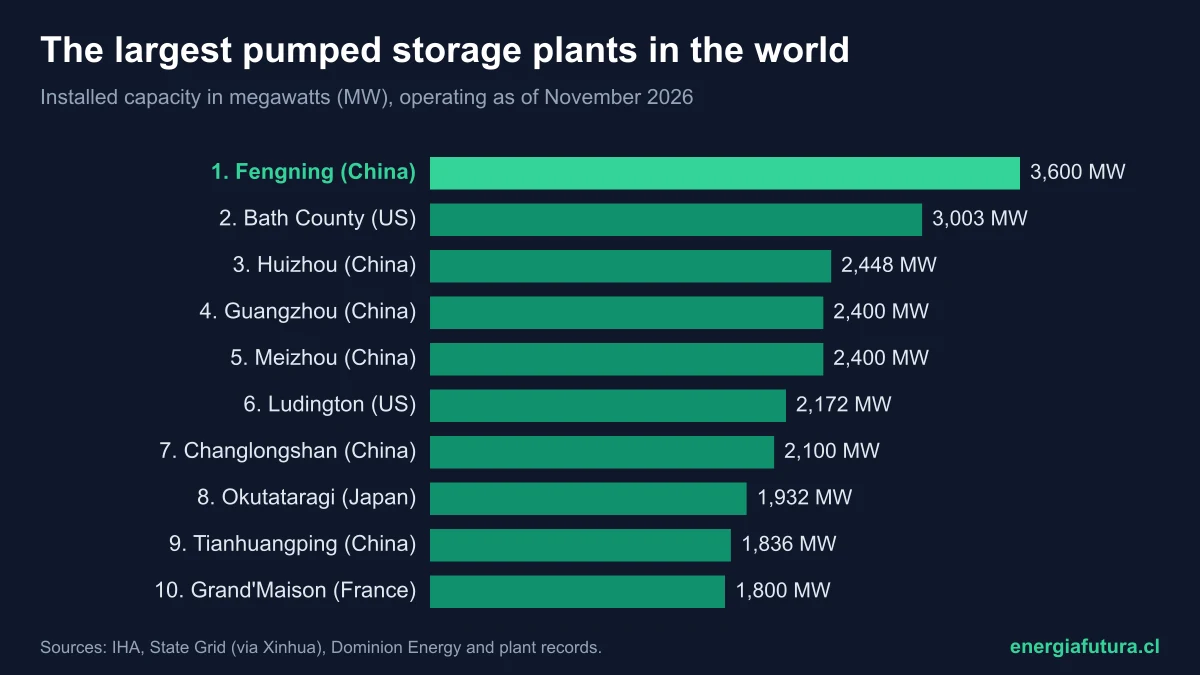
Updated on November 1, 2026. The largest pumped storage power station in the world is Fengning, in China's Hebei province, with an installed capacity of 3,600 MW split across 12 reversible pump-turbines of 300 MW each. It entered full operation on December 31, 2024, according to Xinhua, as published by the Chinese government, and was designed to generate 6.61 billion kWh a year.
Fengning displaced Bath County, in Virginia, United States, which with 3,003 MW was the largest pumped storage plant on the planet for more than three decades, according to the International Hydropower Association (IHA). Of the 10 largest pumped storage plants in the world, six are in China.
A pumped storage plant works like a giant water battery: it uses cheap electricity to pump water from a lower reservoir to an upper one, and releases it through the turbines when the grid needs power. Today it is the most widespread form of energy storage in the world, with 201 GW installed at the end of 2025, according to the IHA's World Hydropower Outlook 2026.
How a pumped storage plant works
A pumped storage plant has two reservoirs at different heights connected by tunnels and a powerhouse with turbines that also work as pumps. When there is surplus electricity, for example at midday on grids with a lot of solar power, the machines pump water up to the upper reservoir. When demand rises, at dusk, the water flows back down through the same turbines and generates electricity. Part of the energy is lost in the cycle, but the plant buys cheap and sells high, and gives the grid backup that can last many hours. That is why it has been considered the great battery of power systems for more than half a century.
Ranking: the 10 largest pumped storage power stations in the world
The following table ranks operating pumped storage plants by installed capacity, the usual measure for comparing them. Storage capacity, in GWh, indicates how much energy they can deliver before the upper reservoir runs dry, and not every plant publishes it.
| Rank | Plant | Country | Capacity (MW) | Storage (GWh) |
|---|---|---|---|---|
| 1 | Fengning | China | 3,600 | ~40 |
| 2 | Bath County | United States | 3,003 | ~24 |
| 3 | Huizhou | China | 2,448 | n/a |
| 4 | Guangzhou (Guangdong) | China | 2,400 | n/a |
| 5 | Meizhou | China | 2,400 | n/a |
| 6 | Ludington | United States | 2,172 | ~19.5 |
| 7 | Changlongshan | China | 2,100 | n/a |
| 8 | Okutataragi | Japan | 1,932 | ~15.5 |
| 9 | Tianhuangping | China | 1,836 | n/a |
| 10 | Grand'Maison | France | 1,800 | ~34.8 |
Sources: IHA and Xinhua (Fengning); Wikipedia's list of pumped-storage power stations, accessed November 1, 2026, for the rest. Grand'Maison shares the 1,800 MW mark with Tumut-3 (Australia) and Jixi, Wendeng and Jinyun (China). n/a: no public information.
If the criterion were stored energy rather than capacity, the order would change: Grand'Maison, with about 34.8 GWh, or Raccoon Mountain, in the United States, with about 36.3 GWh and only 1,652 MW, store more energy than more powerful plants. Fengning, at close to 40 GWh, leads on both measures among operating plants.
Fengning, the largest pumped storage power station in the world, in figures
Construction of Fengning began in June 2013 and was carried out in two phases of six units. It is operated by State Grid Corporation of China, the country's largest grid company. According to the IHA, the plant was originally conceived to support clean power supply for the 2022 Beijing Winter Olympics.
| Fengning: key fact | Figure | Source |
|---|---|---|
| Installed capacity | 3,600 MW | Xinhua / IHA |
| Units | 12 of 300 MW (2 variable-speed) | IHA |
| Design annual generation | 6.61 billion kWh | Xinhua |
| Cumulative generation since 2021 | 8.62 billion kWh | Xinhua (as of December 2024) |
| Coal saved | 480,800 tonnes a year | Xinhua |
| CO₂ avoided | 1.2 million tonnes a year | Xinhua |
| Construction start | June 2013 | IHA |
| Full operation | December 31, 2024 | Xinhua |
Two of its units are variable-speed, supplied by Andritz, which allows pumping power to be adjusted minute by minute. That is a key advantage on grids with a lot of solar and wind power, because the plant can absorb exactly the surplus available at any given moment.
Bath County and the other big plants outside China
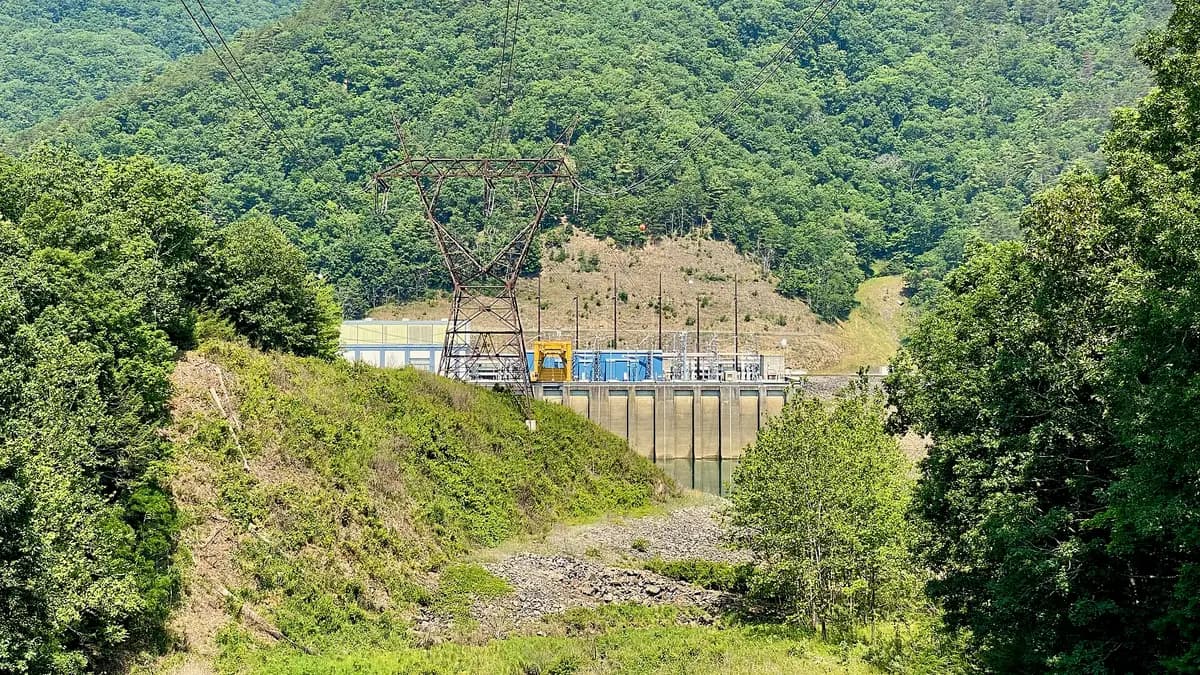
Bath County, in Virginia's Allegheny Mountains, entered service in 1985 and was the largest pumped storage plant in the world until Fengning surpassed it. It has two reservoirs and about 24 GWh of storage. In the United States it is followed by Ludington, on the shores of Lake Michigan, with 2,172 MW.
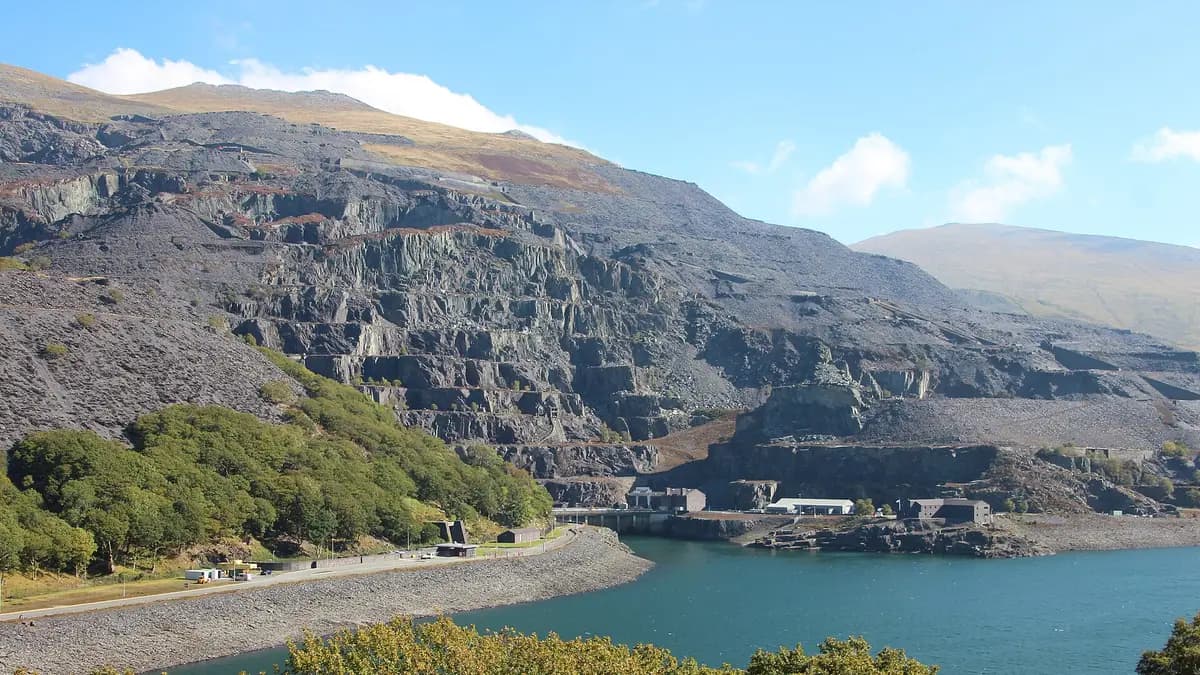
In Europe, the largest is Grand'Maison, in the French Alps, with 1,800 MW. And in the United Kingdom, Dinorwig, in Wales, with 1,728 MW and about 9.1 GWh, is famous for its speed: it is dug inside an old slate quarry and can go from zero to full power in seconds, making it a key backup for the British grid.
How fast pumped storage is growing worldwide
Pumped storage is in its best moment. In 2025, a record 11.6 GW of new capacity came online and global capacity passed 200 GW for the first time, according to the IHA's World Hydropower Outlook 2026, published in June. China installed 7.5 GW of those 11.6 GW and has 218 GW of pumped storage under construction.
| Pumped storage worldwide | Figure | Year |
|---|---|---|
| Global installed capacity | 201 GW | End of 2025 |
| New capacity in the year | 11.6 GW (record) | 2025 |
| New capacity in China | 7.5 GW | 2025 |
| Under construction worldwide | 243 GW | 2025 |
| Under construction in China | 218 GW | 2025 |
| Total project pipeline | 621 GW | 2025 |
Source: IHA, World Hydropower Outlook 2026, via International Water Power, June 24, 2026.
Among the big projects under way are Kannagawa, in Japan, which will reach 2,820 MW when completed, scheduled for 2032, and Snowy 2.0, in Australia, with 2,200 MW and about 350 GWh, which will make it the pumped storage plant with the most stored energy in the world. IHA chief executive Eddie Rich said pumped storage "will double globally in the next 15 years".
Pumped storage competes with lithium batteries, which are installed faster and keep getting cheaper. The largest batteries already exceed 3 GWh, as shown in the ranking of the largest battery in the world, but a plant like Fengning stores more than ten times that energy and can operate for decades.
Pumped storage in Chile: the Paposo case
Chile has no pumped storage plant in operation. One of the best-known projects was Colbún's Paposo pumped storage plant, in the Antofagasta Region, but the company decided in October 2026 to scrap Paposo, worth US$1.4 billion, as batteries take over, since they now solve the same problem faster and with less construction risk.
Still in the running is the Central de Bombeo Atacama, by Susterra and France's Hyvity, which proposes up to 450 MW and 3,600 MWh of storage in Caldera, using desalinated water and two artificial reservoirs, for about US$900 million, according to Reporte Minero. It entered environmental review in July 2026 and is one of the largest projects on the list of Atacama, which has US$7.325 billion under environmental review.
Another known project is Valhalla's Espejo de Tarapacá, which proposes using seawater and the natural drop of the Tarapacá coast for a 300 MW pumped storage plant. It obtained environmental approval a decade ago, according to BNamericas, but there is no public information that construction has started.
To compare scales with conventional generation, the largest power station in the world is a conventional hydroelectric plant, not a pumped storage one: the largest hydroelectric power stations in the world reach 22,500 MW, more than six times Fengning's capacity.
Does your company develop storage, hydropower or batteries? Reach Energía Futura's readers.
See advertising optionsFrequently asked questions
What is the largest pumped storage power station in the world?
Fengning, in Hebei, China, with 3,600 MW of installed capacity and about 40 GWh of storage. It has been in full operation since December 31, 2024.
Which was the largest before Fengning?
Bath County, in Virginia, United States, with 3,003 MW. It was the largest in the world from its commissioning in 1985 until Fengning overtook it.
How much pumped storage capacity is there in the world?
201 GW at the end of 2025, according to the IHA. A record 11.6 GW was added that year, with China contributing 7.5 GW.
Are there pumped storage plants in Chile?
None in operation. Colbún cancelled Paposo in October 2026; the Central de Bombeo Atacama (450 MW, in Caldera) is under environmental review, and Espejo de Tarapacá (300 MW, using seawater) has environmental approval but no known construction.
What is the difference between a pumped storage plant and a battery?
Both store energy for later use. Pumped storage does it with water and gravity, stores many more hours and lasts for decades, but takes years to build. Batteries are installed in months and respond in milliseconds, although they usually store between 2 and 8 hours.
How to cite this data
Energía Futura (2026). The largest pumped storage power station in the world 2026: ranking of the biggest plants. With data from the IHA (World Hydropower Outlook 2026), Xinhua and public plant records, accessed November 1, 2026. Available at https://energiafutura.cl/en/news/the-largest-pumped-storage-power-station-in-the-world-2026-ranking-of-the-biggest-plants. The cover chart may be reproduced by crediting Energía Futura and linking to this page.