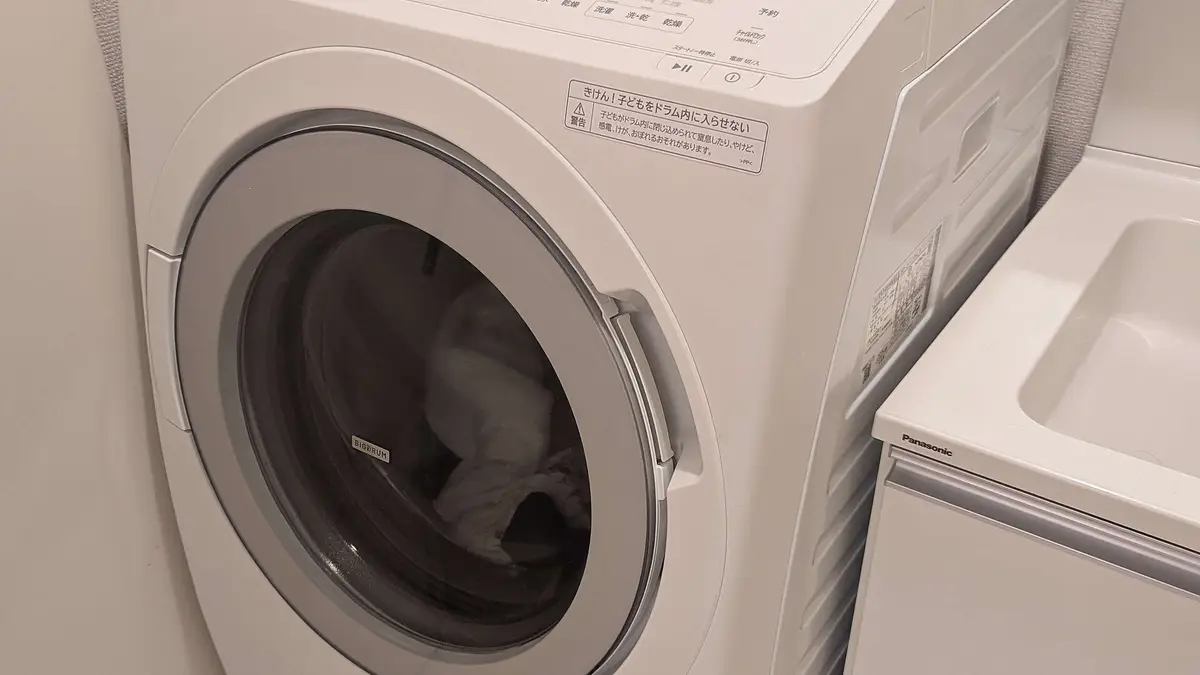
A front-loading washer dryer uses about 2.67 kWh for a full wash-and-dry cycle, around CLP 680 with electricity at CLP 255.27 per kWh. If it only washes, consumption falls to about 0.69 kWh, around CLP 176 per cycle. These are the figures in the EU energy information sheet for the Samsung WD70TA046BE, from the same series sold in Chile.
In Chile, a washer dryer costs from about CLP 243,000 (a 10 kg Hisense) to over CLP 700,000 for 22 kg models, according to prices on Solotodo on 4 November 2026. This guide explains how much electricity it uses in each mode, how much that adds up to per month, what prices are on the market and whether it beats buying a separate washer and dryer.
How much electricity a washer dryer uses
In Europe, every washer dryer must publish an official information sheet with two consumption figures: one for the washing cycle (eco 40-60 programme) and one for the wash-and-dry cycle, both at a combination of full and half loads. The sheet for the Samsung WD70TA046BE, with 7 kg washing and 4 kg drying capacity, gives these figures:
| Cycle | Energy per cycle | Cycle duration at full capacity | Cost per cycle (CLP 255.27/kWh) |
|---|---|---|---|
| Wash only (eco 40-60) | 0.689 kWh | 3 h 28 min | CLP 176 |
| Wash and dry | 2.666 kWh | 6 h 32 min | CLP 681 |
Source: Samsung EU product information sheet (WD70TA046BE); electricity price from CGE's BT1 rate including VAT, in force since 1 October 2026. The sheet notes that actual consumption depends on how the appliance is used. Drying accounts for almost three quarters of the full cycle's consumption: the machine heats air with an element and condenses the moisture, which takes far more energy than washing with water at 40 °C.
Watch the capacity: almost all washer dryers dry fewer kilos than they wash. The Samsung in the example washes 7 kg but dries 4 kg; models sold in Chile range from 10/6 kg to 22/13 kg. If you wash a full load, you have to dry it in two batches or take some clothes out, which doubles the drying cost.
How much a washer dryer costs to run each month
The monthly cost depends on how many cycles you run and how many you dry in the machine. The table uses the sheet's figures and electricity at CLP 255.27 per kWh.
| Monthly use | Energy | Monthly cost |
|---|---|---|
| 12 washes without drying | 8.3 kWh | CLP 2,110 |
| 12 washes with drying | 32.0 kWh | CLP 8,170 |
| 20 washes with drying | 53.3 kWh | CLP 13,610 |
| 20 washes, half with drying | 33.6 kWh | CLP 8,570 |
For perspective: Chile's National Energy Commission uses 180 kWh a month as the consumption of a typical household. A family that washes and dries 20 times a month in the machine would add about 53 kWh, almost 30% of that, as we explain in how much electricity a home in Chile uses. In summer, line-drying and using the dryer only on rainy days is the simplest way to save.
Washer dryer prices in Chile
The table lists washer dryer models with their lowest price on Solotodo, a price comparison site for Chilean shops, on 4 November 2026.
| Model | Wash / dry | Price (CLP) |
|---|---|---|
| Hisense WD1i1041BW | 10 / 6 kg | 242,991 |
| Hisense WD1i1041BT | 10 / 6 kg | 259,990 |
| Midea MLSF-095B/W | 9.5 / 7 kg | 279,990 |
| TCL C2210WD | 10 / 7 kg | 299,990 |
| Samsung WD11TA046BE | 11 / 7 kg | 323,991 |
| Hisense WD3S1443BT2 | 14 / 10 kg | 329,990 |
| Samsung WD12FG6B34BEZS | 12 / 8 kg | 341,991 |
| Midea MF200D130WB/T | 13 / 10 kg | 369,990 |
| LG WD12WVC5S6 | 12 / 7 kg | 386,991 |
| Samsung WD14BB904DGB | 14 / 9 kg | 494,991 |
| LG WD14BVC2S6C | 14 / 8 kg | 559,990 |
| Samsung WD22T6500GV/ZS | 22 / 13 kg | 719,991 |
Source: Solotodo, 4 November 2026. Prices change daily. In Solotodo's listings, most of these models show no Chilean energy efficiency label, so it is worth checking the manufacturer's sheet before buying.
Do you sell energy-efficient appliances? Show your brand to Energía Futura's readers.
See advertising options
Washer dryer or two machines: which is better
The alternative is a separate washer and dryer. In consumption terms, the comparison depends on the type of dryer. According to Spanish consumer group OCU, a heat pump dryer uses 1.33 kWh on a cotton programme, and a resistance (vented or condenser) dryer 2.75 kWh. An efficient front-loading washer uses about 0.44 kWh per wash on the eco 40-60 programme, as we detail in how much electricity a washing machine uses.
| Option | Energy per wash and dry | Cost per cycle (CLP) | Monthly cost (12 cycles, CLP) |
|---|---|---|---|
| Washer + heat pump dryer | 1.77 kWh | 453 | 5,430 |
| Washer dryer (Samsung WD70TA046BE) | 2.67 kWh | 681 | 8,170 |
| Washer + resistance dryer | 3.19 kWh | 815 | 9,780 |
Energía Futura calculations at CLP 255.27/kWh. Consumption sources: Samsung EU sheet, OCU and the EU sheet for the Samsung WW90CGC04DTE. Loads are not identical across machines, so the comparison is a reference.
The bottom line: a washer dryer uses less than a washer plus a resistance dryer, but about 50% more than a washer plus a heat pump dryer. In exchange, it takes half the space and costs less: a 10/6 kg washer dryer starts at about CLP 243,000, while a standalone 10 kg resistance dryer costs about CLP 240,000 on Solotodo, before adding the washer. Heat pump dryers are more expensive, as we explain in the guide to low-consumption dryers.
- Small flat or no room for two machines: a washer dryer is the best option.
- Large family that tumble-dries almost everything: two machines with a heat pump dryer use less energy and dry more kilos per batch.
- Little drying, mostly in winter: a basic washer dryer is enough; in summer, line-dry.
What to check before buying a washer dryer
Beyond price, there are five things worth checking on each model's spec sheet:
- Drying kilos, not just washing kilos: this figure determines how much laundry you can dry at once. For a family of four, aim for at least 7 or 8 kg of drying capacity.
- Drying type: most use condensation with a heating element; few washer dryers use a heat pump, which uses less energy but costs more.
- Inverter motor: usually quieter and more efficient when spinning; almost all models in the table have one.
- Spin speed: the higher the speed (1,200 to 1,400 rpm), the less water stays in the clothes and the shorter the drying.
- Water use: many condenser machines use water to cool the air during drying; the EU sheet reports it per cycle.
Another point is time: a full wash-and-dry cycle can take more than six hours on the efficient programme, as the Samsung sheet shows. Running it at night or while nobody is home keeps it from getting in the way. And since drying drives the cost, moisture-sensor drying programmes, which stop when clothes are dry, save energy compared with fixed-time ones.
How to spend less with a washer dryer
- Spin at top speed before drying: the less water in the clothes, the less energy drying takes.
- Do not overload the dryer: respect the drying kilos, which are lower than the washing kilos.
- Wash cold or at 30 °C when clothes are not very dirty: heating water is what uses most energy when washing.
- Use the eco 40-60 programme, which is longer but the most efficient.
- Clean the lint filter and condenser as the manual says.
- Line-dry when it is sunny and save the dryer for humid days.
Frequently asked questions
How much electricity does a washer dryer use per cycle?
About 2.7 kWh for a wash-and-dry cycle and about 0.7 kWh for washing only, according to the EU sheet for the Samsung WD70TA046BE.
How much does a wash-and-dry cycle cost in Chilean pesos?
About CLP 680 with electricity at CLP 255.27 per kWh (CGE, October 2026). Washing only costs about CLP 176.
How much does a washer dryer cost in Chile?
From about CLP 243,000 (10/6 kg) to CLP 720,000 or more for 22/13 kg models, according to Solotodo on 4 November 2026.
Does a washer dryer use more energy than a standalone dryer?
It uses less than a washer plus a resistance dryer, but more than a washer plus a heat pump dryer.
Why does it dry fewer kilos than it washes?
Because the drum needs space for hot air to circulate through the clothes. That is why a 10 kg washer usually dries 6 or 7 kg.