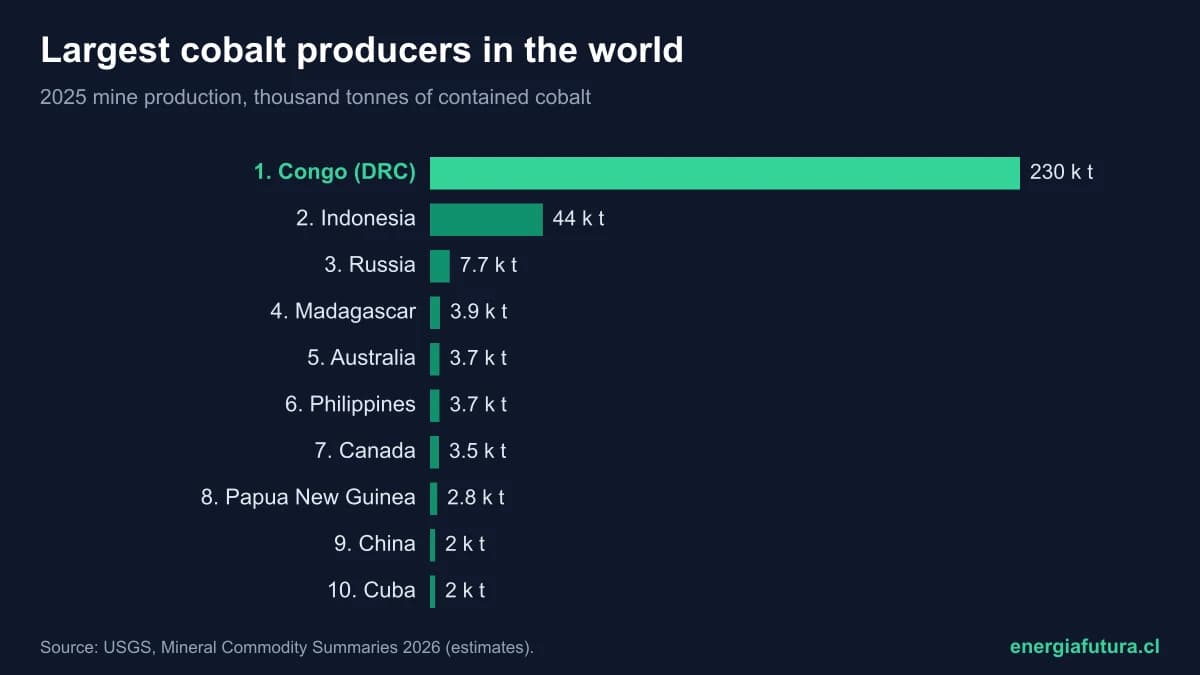
Updated on November 1, 2026. The Democratic Republic of the Congo is the largest cobalt producer in the world, with estimated mine production of 230,000 tonnes of contained cobalt in 2025, about 74% of the world total of 310,000 tonnes, according to the U.S. Geological Survey (USGS) cobalt summary, Mineral Commodity Summaries 2026, published in February. Indonesia is second, with 44,000 tonnes (14%).
Cobalt is a key metal for NMC and NCA lithium-ion batteries, the chemistries used by many electric cars, as well as for aircraft turbine superalloys. China is the world's largest refiner and consumer, mainly for the battery industry, according to the USGS.
Chile does not appear in the ranking: it has no reported production in the USGS table. But Capstone Copper's Santo Domingo project, in the Atacama Region, could produce between 4,500 and 6,000 tonnes of cobalt a year, a figure that would place it among the world's ten largest producers if it is built.
Ranking: the largest cobalt producers in the world in 2025
| Rank | Country | 2024 production (t) | 2025 production (t) | 2025 share |
|---|---|---|---|---|
| 1 | Congo (DRC) | 226,000 | 230,000 | 74.2% |
| 2 | Indonesia | 35,000 | 44,000 | 14.2% |
| 3 | Russia | 8,000 | 7,700 | 2.5% |
| 4 | Madagascar | 3,100 | 3,900 | 1.3% |
| 5 | Australia | 4,780 | 3,700 | 1.2% |
| 6 | Philippines | 3,100 | 3,700 | 1.2% |
| 7 | Canada | 3,350 | 3,500 | 1.1% |
| 8 | Papua New Guinea | 2,630 | 2,800 | 0.9% |
| 9 | China | 2,000 | 2,000 | 0.6% |
| 10 | Cuba | 3,450 | 2,000 | 0.6% |
| 11 | Turkey | 2,200 | 1,900 | 0.6% |
| — | United States | 200 | 300 | 0.1% |
| — | Other countries | 7,780 | 9,100 | 2.9% |
| — | World total | 302,000 | 310,000 | 100% |
Source: USGS, Mineral Commodity Summaries 2026 (2025 figures estimated, in tonnes of contained cobalt). Shares calculated by Energía Futura on the rounded world total; the USGS reports 73% for Congo and 14% for Indonesia.
Concentration is extreme: Congo and the runner-up, Indonesia, account for almost 90% of the world's mined cobalt. Between the two years, world production grew from 302,000 to 310,000 tonnes, and almost all of the increase came from Indonesia, which went from 35,000 to 44,000 tonnes thanks to cobalt recovered at its nickel plants.
Indonesia is the fastest-growing producer. Its cobalt does not come from dedicated cobalt mines, but from plants that process nickel laterites, a type of deposit the USGS identifies as one of the world's major sources of cobalt resources, along with the copper deposits of Congo and Zambia. As Indonesia expands its nickel industry for batteries, its cobalt output rises as a by-product: in a single year it gained 9,000 tonnes, more than any other country outside Congo produces.
The United States illustrates how dependent the West is. Its only mined cobalt, about 300 tonnes in 2025, came from the Eagle nickel-copper mine in Michigan, and the concentrate was exported for processing. The country imported an estimated 14,000 tonnes and its net import reliance reached 79% of apparent consumption, according to the USGS. In 2025 Washington even published a tender to buy 7,480 tonnes of cobalt over five years for its National Defense Stockpile, but it was cancelled before the end of the year.
Congo, the largest cobalt producer in the world
Most Congolese cobalt comes as a by-product of the large copper-cobalt mines in the south of the country, in the Lualaba and Haut-Katanga provinces, home to deposits such as those of Kolwezi and Mutanda. Part of it is extracted through artisanal mining, with labor and child-labor risks documented by international organizations, which has led battery makers to demand traceability.
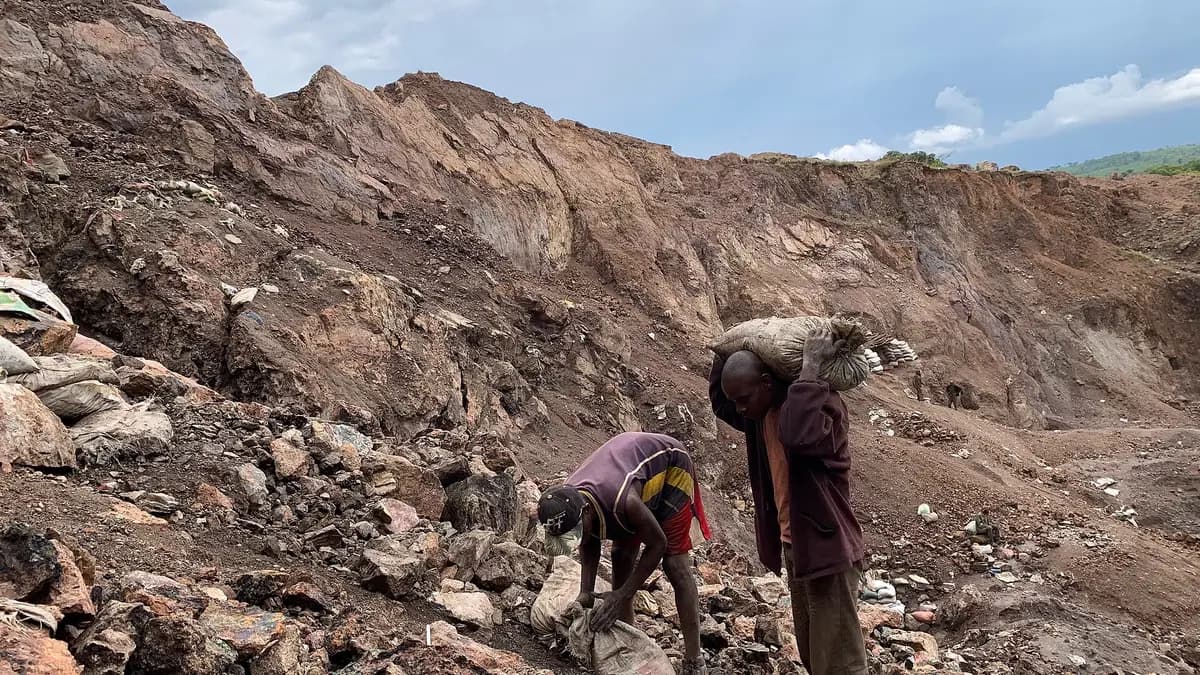
In February 2025, Congo temporarily banned cobalt exports to address oversupply and low prices. In October 2025 it replaced the ban with export quotas: 18,125 tonnes for the rest of 2025 and up to 96,600 tonnes a year in 2026 and 2027, including 9,600 tonnes for national strategic reserves, according to the USGS.
| Congo's cobalt export quotas | Tonnes of contained cobalt |
|---|---|
| Rest of 2025 (from October) | 18,125 |
| 2026 | up to 96,600 |
| 2027 | up to 96,600 |
| Of which, national strategic reserve (per year) | 9,600 |
| Congo mine production in 2025 (reference) | 230,000 |
Source: USGS, Mineral Commodity Summaries 2026.
The effect on prices was strong but uneven. The average cobalt price on the London Metal Exchange went from US$11.84 per pound in 2024 to about US$15 in 2025, according to the USGS. Later, cobalt hydroxide fell about 31% in the third quarter of 2026, from around US$56,300 to US$39,140 per tonne, according to Benchmark Mineral Intelligence data cited by Agence Ecofin.
Cobalt reserves: where the cobalt of the future lies
World cobalt reserves total about 12 million tonnes, and half of them are in Congo. Australia is second, with 1.7 million, although the USGS notes that only 680,000 tonnes meet the Australian JORC standard. Indonesia, Russia and Cuba complete the top places.
| Rank | Country | Cobalt reserves (t) | Share |
|---|---|---|---|
| 1 | Congo (DRC) | 6,000,000 | 50% |
| 2 | Australia | 1,700,000 | 14% |
| 3 | Russia | 800,000 | 6.7% |
| 4 | Indonesia | 760,000 | 6.3% |
| 5 | Cuba | 500,000 | 4.2% |
| 6 | Philippines | 260,000 | 2.2% |
| 7 | Canada | 220,000 | 1.8% |
| 8 | China | 160,000 | 1.3% |
| — | Other countries | 780,000 | 6.5% |
| — | World total | 12,000,000 | 100% |
Source: USGS, Mineral Commodity Summaries 2026. Shares calculated by Energía Futura. Identified land-based resources total about 25 million tonnes, and the USGS estimates about 5 billion tonnes contained in polymetallic nodules on the seafloor.
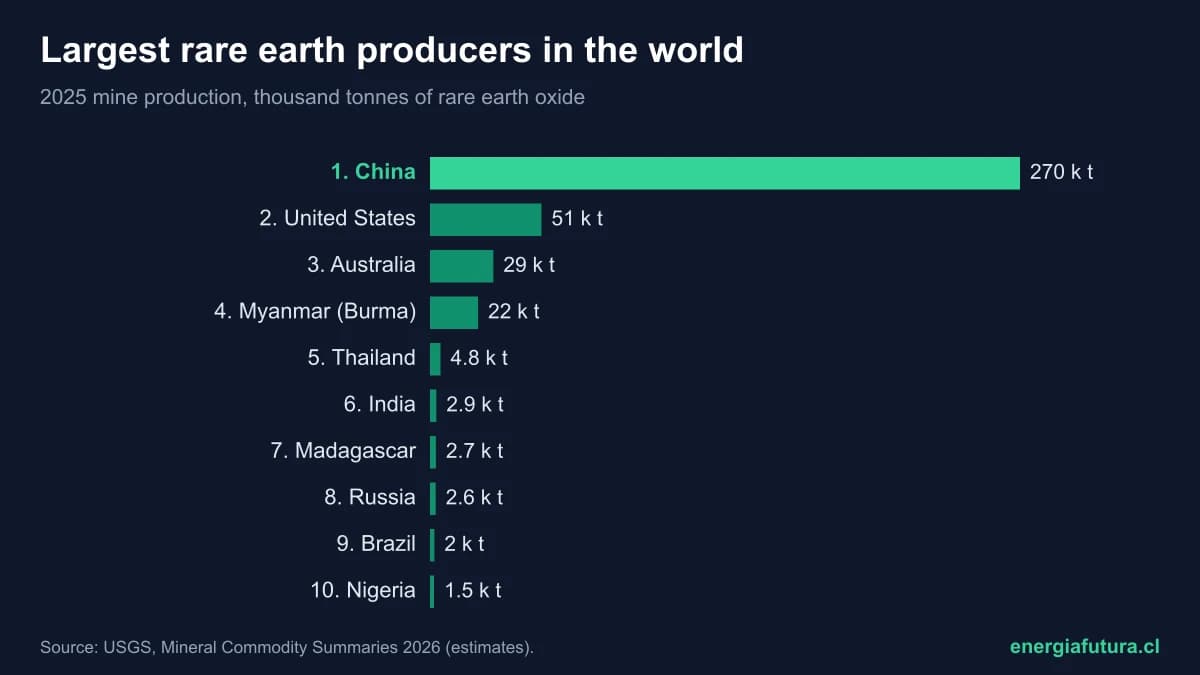
Cobalt shares a pattern of geographic concentration with other critical minerals. Something similar happens with China in the ranking of the largest rare earth producers in the world, and to a lesser extent with Australia and Chile in lithium.
Cobalt in Chile: Santo Domingo and tailings
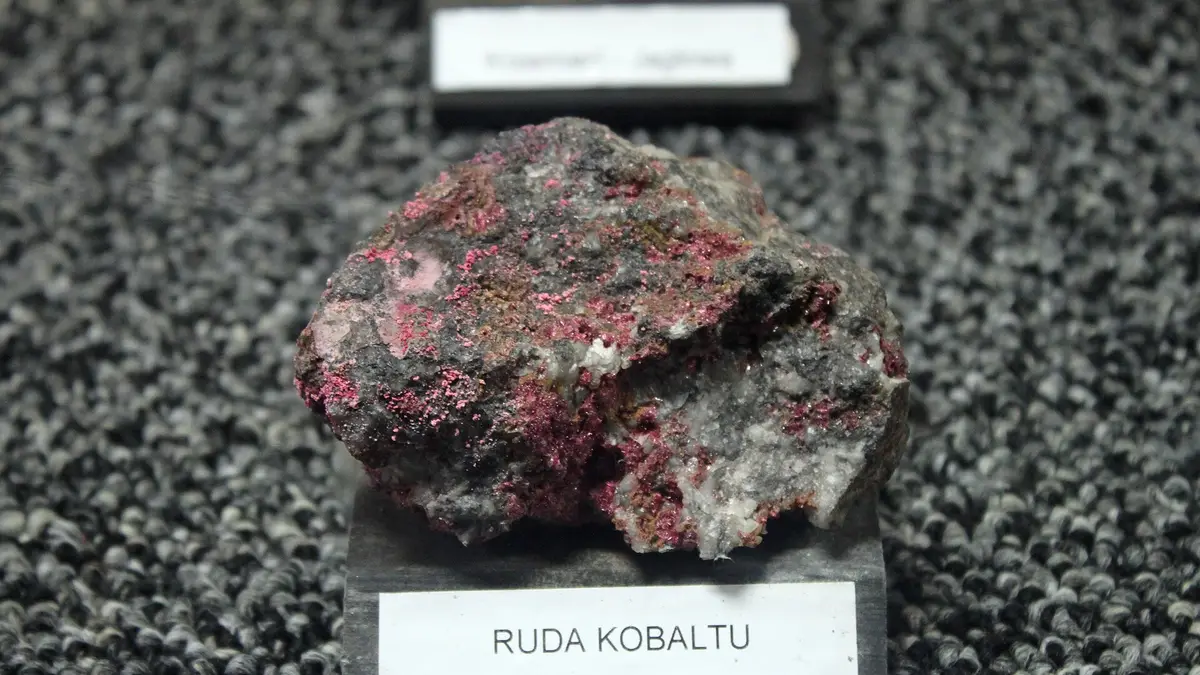
Chile produces copper on a large scale, but does not currently mine cobalt commercially. The main bet is Capstone Copper's Mantoverde-Santo Domingo district, in the Atacama Region, which the company describes as one of the largest and lowest-cost cobalt projects in the western hemisphere. In October, the miner announced investments of more than US$3 billion in Chile, although without a construction date for Santo Domingo.
The other possible source is tailings. A 2017 study for Corfo and Sernageomin, led by geologist Brian Townley, estimated that Chile could produce about 15,000 tonnes of cobalt a year from its tailings in the medium term, as reported by Reporte Minero. At that level, Chile would rank third in the world, behind Congo and Indonesia.
| Chile and cobalt | Figure | Source |
|---|---|---|
| Commercial cobalt production in 2025 | Not reported | USGS 2026 |
| Santo Domingo potential (Capstone) | 4,500 to 6,000 t/year | Capstone Copper |
| Estimated potential from tailings | ~15,000 t/year | Corfo-Sernageomin study, 2017 |
| Rank it would hold at 6,000 t/year | 3rd in the world | Energía Futura calculation with USGS data |
For Chile, cobalt also has a sustainable mining angle: recovering it from tailings or as a copper by-product makes use of material already extracted, instead of opening new mines. It is the same argument driving tailings reprocessing for other metals, and it coexists with the declining use of cobalt in batteries.
The future of cobalt in batteries
The cobalt content of lithium-ion batteries, its main use worldwide, has been falling, and cobalt-free LFP (lithium iron phosphate) batteries hold a significant share in China, according to the USGS. That partly explains why prices have been volatile despite Congo's dominance: demand is growing, but less than expected five years ago.
Even so, nickel-cobalt chemistries remain the preferred choice for longer-range cars, and copper and cobalt often come from the same deposits. That is why the cobalt ranking moves in parallel with that of the largest copper producers in the world, where Congo is already second behind Chile.
Does your company work in sustainable mining, batteries or critical minerals? Reach Energía Futura's readers.
See advertising optionsFrequently asked questions
Which is the largest cobalt producer in the world?
The Democratic Republic of the Congo, with about 230,000 tonnes in 2025, roughly three quarters of the world total, according to the USGS.
How much cobalt is produced in the world?
About 310,000 tonnes of contained cobalt in 2025, compared with 302,000 in 2024, according to USGS estimates.
Which country has the largest cobalt reserves?
Congo, with 6 million tonnes, half of the world's 12 million tonnes of reserves. Australia follows with 1.7 million.
Does Chile produce cobalt?
Not commercially, according to the USGS. Capstone Copper's Santo Domingo project could produce between 4,500 and 6,000 tonnes a year, and a 2017 study estimated potential of about 15,000 tonnes a year from tailings.
What is cobalt used for?
Mainly in NMC and NCA lithium-ion batteries. Also in superalloys for aircraft turbines, carbides for cutting tools, magnets and chemicals.
How to cite this data
Energía Futura (2026). Largest cobalt producers in the world 2026: ranking of countries, reserves and where Chile stands. With data from the USGS (Mineral Commodity Summaries 2026), accessed November 1, 2026. Available at https://energiafutura.cl/en/news/largest-cobalt-producers-in-the-world-2026-ranking-of-countries-reserves-and-chile. The cover chart may be reproduced by crediting Energía Futura and linking to this page.