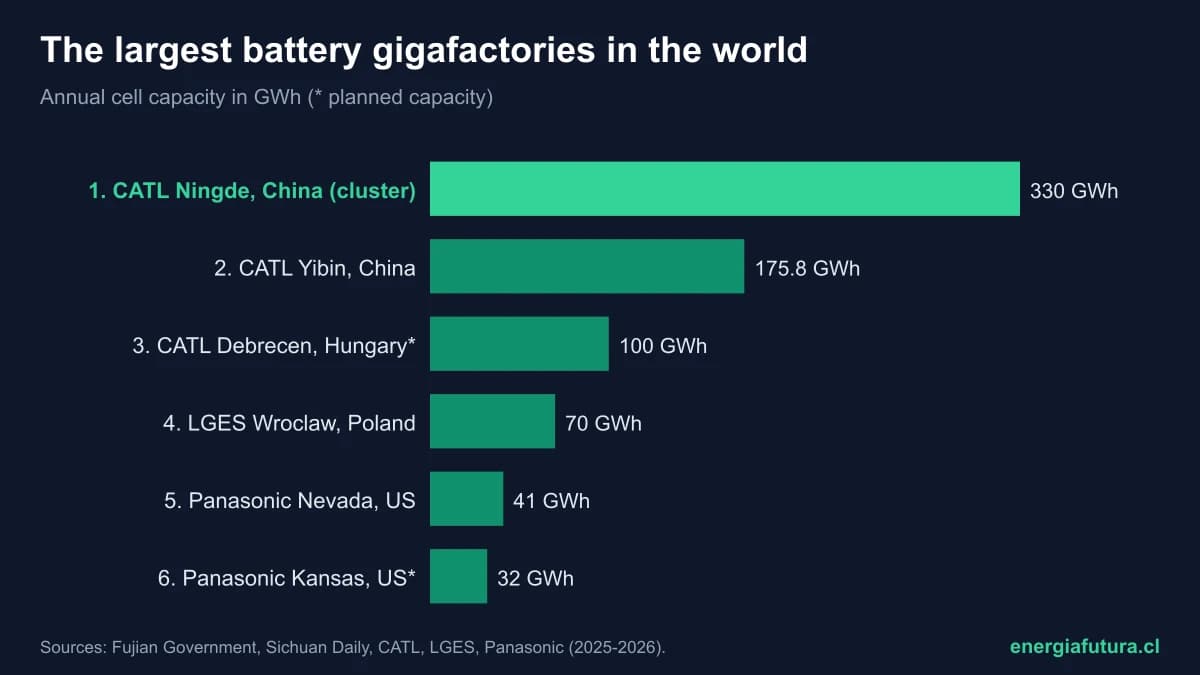
Updated on November 3, 2026. The world's largest concentration of battery factories is in Ningde, in China's Fujian province, where CATL's production bases had 330 GWh of annual capacity at the end of 2025, with another 170 GWh under construction or planned, according to the Fujian provincial government. As a single site, CATL's base in Yibin (Sichuan) reached 175.8 GWh in 2025, according to Sichuan Daily.
To put it in perspective: 330 GWh is enough to build batteries for about 5 million electric cars of 65 kWh a year. Outside China, the largest plant in operation is LG Energy Solution's in Wroclaw, Poland, with about 70 GWh, and the one set to grow the most is CATL's in Debrecen, Hungary, which began trial production on September 22, 2026 with a 100 GWh target. This data sheet ranks the largest gigafactories using figures from official sources and the companies themselves.
Ranking of the largest battery gigafactory in the world
There is no single official register of capacity by factory: each company reports in its own way and some figures refer to hubs with several plants. That is why the table separates installed from planned capacity and gives the source for each figure.
| Rank | Gigafactory | Country | Annual capacity | Status | Source |
|---|---|---|---|---|---|
| 1 | CATL, Ningde hub (several bases) | China | 330 GWh (+170 GWh under construction or planned) | Operating (end of 2025) | Fujian Government |
| 2 | CATL, Yibin base (Sichuan Times) | China | 175.8 GWh | Operating (2025) | Sichuan Daily |
| 3 | CATL Debrecen | Hungary | 100 GWh planned (phase 1: 34 GWh) | Trial production since Sep 22, 2026 | CATL via CarNewsChina |
| 4 | LG Energy Solution Wroclaw | Poland | ~70 GWh (LG has cited up to 86 GWh) | Operating | LG |
| 5 | Panasonic Energy, Nevada (Tesla Gigafactory) | United States | ~41 GWh | Operating since 2017 | Panasonic via Electrive |
| 6 | Panasonic Energy, De Soto (Kansas) | United States | ~32 GWh target | Mass production since Jul 2025 | Panasonic via Electrive |
Sources: Fujian Government (January 2026), Sichuan Daily (2026), CATL via CarNewsChina (September 22, 2026), LG Energy Solution and Panasonic Energy via Electrive (July 2025). Capacities are nameplate: what a plant actually produces depends on its utilization rate.
Ningde and Yibin: where the largest gigafactory in the world is
CATL was founded in Ningde in 2011 and turned the city into the largest battery hub on the planet. Ningde's lithium battery cluster produced more than 300 billion yuan (about US$43 billion) in 2025, according to the Fujian government. Within that hub is the Fuding base, where CATL plans to add 40 GWh of sodium-ion batteries for 5 billion yuan to reach 149 GWh, according to an environmental filing cited by CnEVPost in May 2026.
Yibin, in Sichuan, is the fastest-growing case: CATL's base went from 8.8 GWh at start-up in 2021 to 175.8 GWh in 2025, and its tenth phase was 95% complete. The whole city, including other companies, had 270 GWh of battery capacity. Sichuan's power is mostly hydroelectric, which lowers the carbon footprint of every cell made there, an argument CATL uses with European customers.
Size alone does not guarantee success. A gigafactory's capacity is a nameplate figure: the IEA notes that competing in this industry requires average production yields above 90%, meaning that nine out of ten cells coming off the line must pass quality control, and that utilization is far below 100% in many plants. In its scenarios, utilization only rises to 85% of nameplate capacity. That is why some European projects announced with dozens of GWh, such as Northvolt's in Sweden, ended in bankruptcy before reaching their targets, while the Chinese hubs, with decades of supplier networks around them, keep expanding. Scale, experience and a nearby supply chain explain why the largest gigafactories are concentrated in a handful of Chinese cities.
The largest gigafactories outside China
In Europe, LG Energy Solution's plant in Wroclaw (Poland) has been the benchmark since 2017. LG has described it with capacities of 70 to 86 GWh, and in 2026 it began allocating part of its output to stationary batteries. The competition comes from CATL in Debrecen (Hungary), an investment of about €7.3 billion according to TechNode, which began trial cell production on September 22, 2026 with two lines and a first phase of 34 GWh. If it reaches 100 GWh, it will be CATL's largest base outside China.
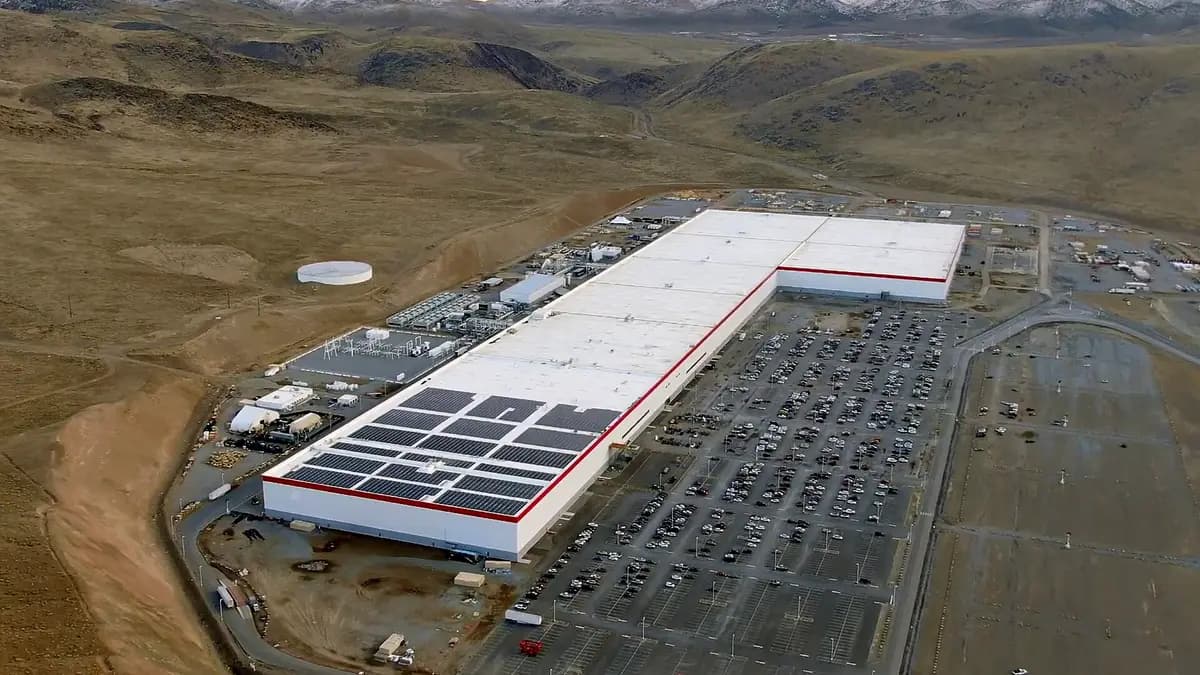
In the United States, the best-known plant is Tesla's Gigafactory in Nevada, where Panasonic makes cylindrical cells with about 41 GWh a year. In July 2025, Panasonic opened its second plant in De Soto, Kansas, with a 32 GWh target, according to Electrive; together, its U.S. capacity would reach about 73 GWh, although the company no longer gives a date for reaching full output in Kansas.
China holds more than 80% of world capacity
Global nameplate lithium-ion battery manufacturing capacity exceeded 4 TWh at the end of 2025, up about 30% in a year, and China holds more than 80%, while the European Union and the United States hold 6% to 7% each, according to the International Energy Agency's Global EV Outlook 2026. Capacity grew about 50% in the EU and the US, and just over 25% in China.
| World indicator | Value (2025) | Source |
|---|---|---|
| Nameplate lithium-ion battery manufacturing capacity | Over 4 TWh | IEA, Global EV Outlook 2026 |
| China's share of capacity | Over 80% | IEA |
| EU and US share (each) | 6% to 7% | IEA |
| Batteries deployed in electric vehicles | 1.2 TWh (+30%) | IEA |
| LFP share of EV batteries | Over 55% | IEA |
| Fall in average battery prices | -8% | IEA |
That capacity comfortably exceeds demand: electric vehicles used 1.2 TWh of batteries in 2025, with stationary storage and electronics making up the rest of the market. The oversupply helps explain why average battery prices fell 8% in 2025 and why storage projects keep getting cheaper. The largest systems using those cells are in our ranking of the largest battery in the world.
Why Chile has no gigafactory
Chile is the world's third-largest lithium producer, behind Australia and China, as our ranking of the largest lithium-producing countries shows, but it does not make cells. A gigafactory needs, besides lithium, graphite, nickel or iron and phosphate, cathodes and anodes, a chemical supply chain and, above all, nearby customers: plants are built next to carmakers. Chile has no car industry, and its stationary battery market, although growing, is supplied with containers imported from China.
What has been discussed in Chile are intermediate stages, such as cathode plants or higher-value lithium compounds, linked to Corfo's contracts with lithium producers. Graphite, the other critical input, is almost entirely controlled by China, as our ranking of the largest graphite producers shows. The lack of a local car industry is the main barrier that none of these plans has solved.
Methodology
The ranking covers lithium-ion cell gigafactories (not module or pack assembly) with capacity reported by a government or by the company itself in 2025 or 2026. The Ningde hub is presented as a group of bases, because the Fujian government reports the aggregate figure; Yibin is presented as a single base. Planned capacities are marked as such. Other large plants, such as BYD's, are not included because there are no verifiable public figures by site. LG Energy Solution's Wroclaw figures vary by source (70 to 86 GWh), and the most conservative is used. This ranking will be updated at the same URL.
How to cite this data
Energía Futura (2026). "Largest battery gigafactory in the world 2026: ranking of the biggest cell factories". Updated on November 3, 2026. energiafutura.cl/en/news/largest-battery-gigafactory-in-the-world-2026-ranking-of-the-biggest-cell-factories. Data: Fujian Government, Sichuan Daily, CATL, LG Energy Solution, Panasonic Energy and IEA.
Does your company work in batteries, storage or electric mobility? Reach Energía Futura's readers.
See advertising optionsFrequently asked questions
What is the largest battery gigafactory in the world?
As a hub, CATL's in Ningde (China), with 330 GWh at the end of 2025. As a single base, CATL's in Yibin, with 175.8 GWh in 2025.
What is the largest gigafactory in Europe?
Today, LG Energy Solution's in Wroclaw (Poland), with about 70 GWh. CATL's in Debrecen (Hungary) targets 100 GWh and began trial production in September 2026.
How much battery manufacturing capacity is there in the world?
More than 4 TWh a year at the end of 2025, according to the IEA, with more than 80% in China.
What does GWh mean for a battery factory?
It is the total energy the cells a plant makes in a year can store. 1 GWh is enough for the batteries of about 15,000 cars of 65 kWh.
Is there a gigafactory in Latin America?
There are no gigafactory-scale cell plants operating in the region; there are pack assembly and battery materials projects, but cells are imported, mostly from China.