Updated on 26 October 2026. The largest electric ship in the world is the China Zorrilla, a 130-metre catamaran built by Australian shipyard Incat for the ferry operator Buquebus. It carries more than 40 MWh of batteries, weighing over 250 tonnes, and can take 2,100 passengers and 225 vehicles. After a ceremony in Buenos Aires on 21 October 2026, it began commercial service between Buenos Aires and Colonia del Sacramento, across the River Plate, Shippax reported on 23 October.
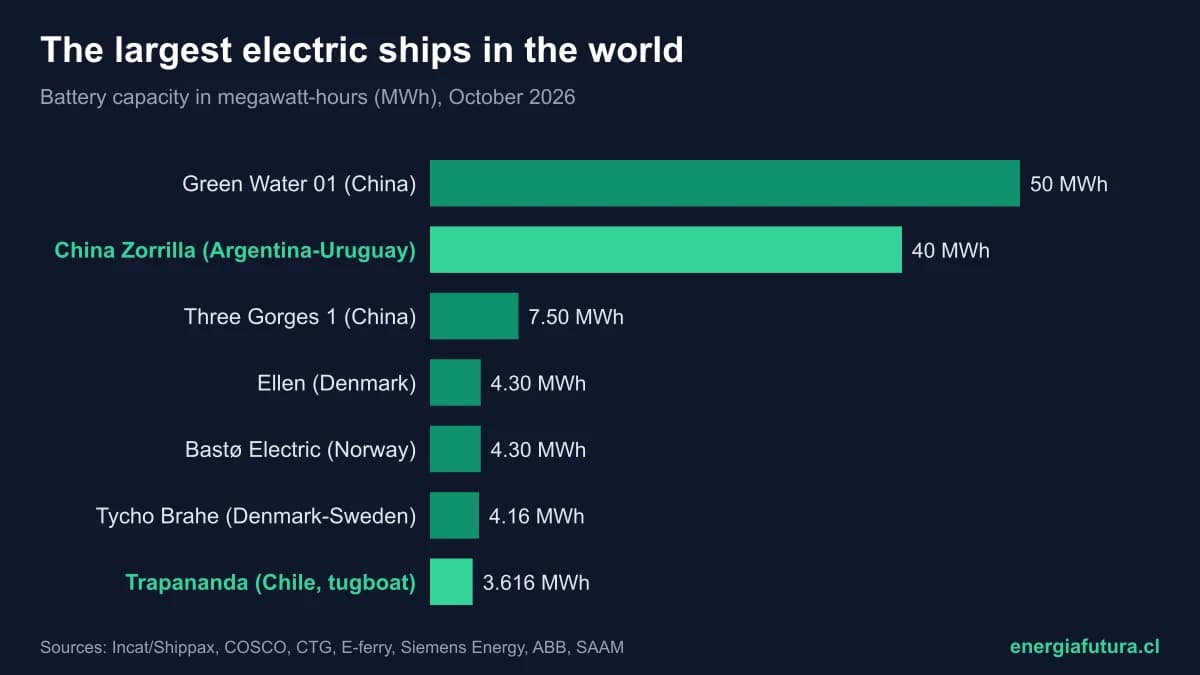
Its battery is about ten times that of the electric ferries that held the record five years ago, such as Denmark's Ellen or Norway's Bastø Electric, at 4.3 MWh each. Only one ship declares more stored energy: the Chinese container ship Green Water 01, operated by COSCO Shipping, with 50 MWh in swappable batteries. This is the ranking of the biggest battery ships in the world and how each record is measured.
Ranking: the largest electric ship in the world and the runners-up
The table ranks 100% battery-electric ships in operation by battery capacity, the figure that best sums up how much energy each one moves. Only vessels with figures published by the builder, the owner or the equipment supplier are included. Hybrids that combine batteries with diesel engines are left out.
| # | Ship | Owner and route | Type | Length | Battery | In service since |
|---|---|---|---|---|---|---|
| 1 | Green Water 01 | COSCO Shipping, Shanghai-Nanjing (China) | Container ship (700 TEU) | 120 m | 50 MWh (expandable to 80 MWh) | 2024 |
| 2 | China Zorrilla | Buquebus, Buenos Aires-Colonia | Passenger and car ferry | 130 m | More than 40 MWh | October 2026 |
| 3 | Yangtze River Three Gorges 1 | China Yangtze Power, Yichang (China) | River cruise ship | 100 m | 7.5 MWh | 2022 |
| 4 | Ellen | Ærø, Søby-Fynshav (Denmark) | Passenger and car ferry | 59.4 m | 4.3 MWh | 2019 |
| 5 | Bastø Electric | Bastø Fosen, Moss-Horten (Norway) | Passenger and car ferry | 139.2 m | 4.3 MWh | 2021 |
| 6 | Tycho Brahe and Aurora | ForSea, Helsingør-Helsingborg | Passenger and car ferries | Over 100 m | 4.16 MWh each | 2018 (conversion) |
Sources: Shippax (China Zorrilla), electrive with COSCO data (Green Water 01), China Three Gorges Corporation via Kyodo (Three Gorges 1), Plugboats with Leclanché data (Ellen), electrive with Siemens Energy data (Bastø Electric) and ABB (Tycho Brahe and Aurora). Accessed on 26 October 2026. The ranking may be incomplete: China operates electric river vessels whose specifications are not always published outside the country.
Why the largest is not the one with the biggest battery
The title of largest electric ship in the world depends on what is measured. By battery capacity, first place goes to Green Water 01, with 50 MWh in battery containers that are charged in port or swapped by crane. By passengers and vehicles, the China Zorrilla wins comfortably. And by length, the longest is Norway's Bastø Electric, at 139.2 metres, although its battery is almost ten times smaller.
Incat and Buquebus present the China Zorrilla as the largest battery-electric ship in the world, and trade outlets such as Shippax and Riviera report it that way. It is the criterion most used in shipping, which measures a vessel's size by its volume and carrying capacity, not just its length.
China Zorrilla, the largest electric ship in the world in 2026
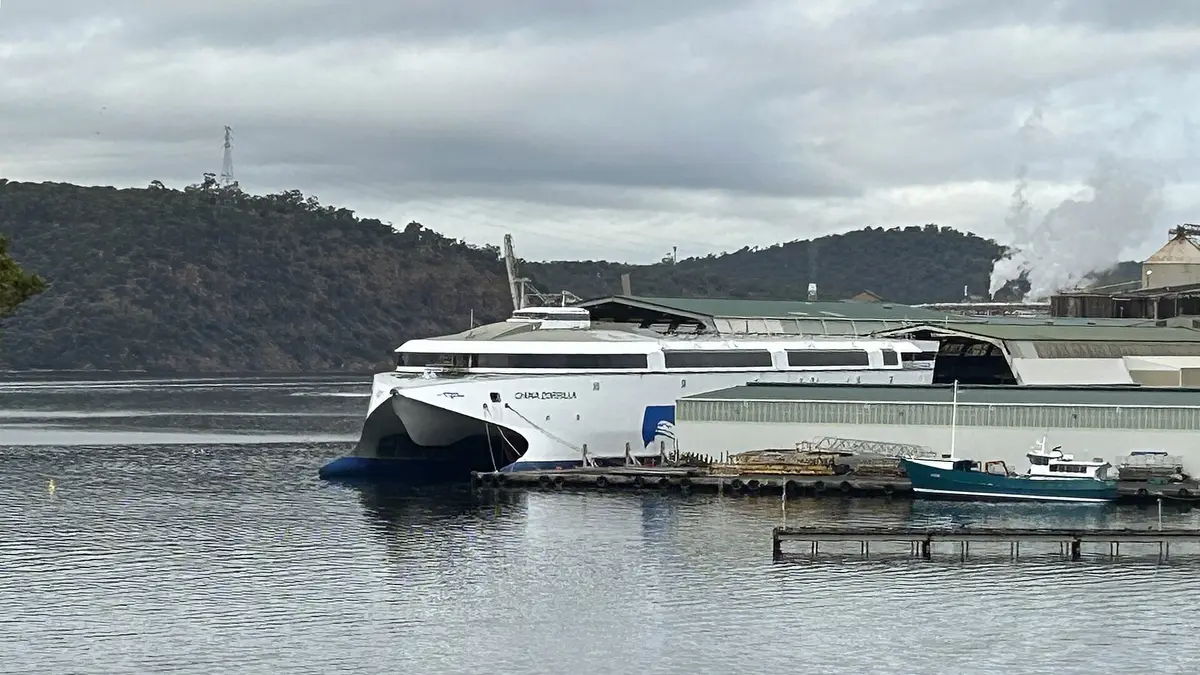
The ship was built in Hobart, on the Australian island of Tasmania, under the provisional name Hull 096. It was launched on 2 May 2025 and Buquebus named it after Uruguayan actress China Zorrilla (1922-2014). The original 2019 order was for a natural gas and diesel ferry; in 2023 the operator and the shipyard decided to switch to full electric propulsion.
It travelled to South America aboard a heavy-lift vessel and arrived in Uruguay in September 2026. The batteries power eight electric motors driving eight Wärtsilä waterjets. The crossing between Buenos Aires and Colonia, about 55 to 60 kilometres, takes around 90 minutes, a time that fits the range reported for the ship.
| Item | China Zorrilla |
|---|---|
| Builder | Incat Tasmania (Australia) |
| Owner | Buquebus |
| Route | Buenos Aires (Argentina)-Colonia del Sacramento (Uruguay) |
| Length | 130 m |
| Battery | More than 40 MWh, over 250 tonnes |
| Passengers | 2,100 |
| Vehicles | 225 |
| Propulsion | 8 electric motors and 8 Wärtsilä waterjets |
| Launch | 2 May 2025 |
| Start of commercial service | October 2026 |
Source: Shippax (23 October 2026) and Incat statements reported by the trade press. To put the battery in perspective: 40 MWh could cover a month of electricity use for about 220 Chilean homes, which use around 180 kWh a month according to the reference household of Chile's National Energy Commission (CNE), as explained in how much electricity a home in Chile uses per month.
The figure can also be compared with storage systems on land. The battery at the Estela Solar plant in Tarapacá, Chile, holds 935 MWh, about 23 times what the ship carries. The difference is that the ship has to carry all that weight and recharge it within minutes at each port. The ranking of land-based systems is in the largest battery in the world.
Green Water 01: the ship with the biggest battery
COSCO Shipping's Green Water 01 is a river-sea container ship about 120 metres long with a capacity of 700 TEU (twenty-foot containers). It began operating in 2024 between Shanghai and Nanjing, along the Yangtze River, a route of almost 1,000 kilometres. According to information released by the company and reported by electrive, its base battery is 50,000 kWh and can reach 80,000 kWh by adding more battery containers.
There is a caveat: the batteries sit in containers that are charged on land or swapped, so the capacity on board can vary from voyage to voyage. Sources also differ on how many modules it carries, so the 50 MWh figure should be read as the capacity declared by the owner.
The electric ferries that held the record
Before the China Zorrilla, the title of largest electric ship in the world passed through several ferries in northern Europe, where short crossings and cheap, clean electricity made battery propulsion profitable.
- Tycho Brahe and Aurora (2018): two 1991 ferries linking Helsingør (Denmark) and Helsingborg (Sweden) on a crossing of just 4 km. ABB converted them to battery power with 4,160 kWh each, in 640 batteries of about 90 kg. A robotic arm connects them at each port for 5 to 9 minutes.
- Ellen (2019): a 59.4-metre Danish ferry with a 4.3 MWh Leclanché battery. Its merit is distance: it covers 22 nautical miles (about 41 km) between the islands of Ærø and Als, a record for an electric ferry when it entered service.
- Bastø Electric (2021): built in Turkey for the Moss-Horten crossing on the Oslofjord. It is 139.2 metres long, carries 600 passengers and 200 cars, and uses a 4.3 MWh Siemens Energy battery with fast charging of up to 9 MW.
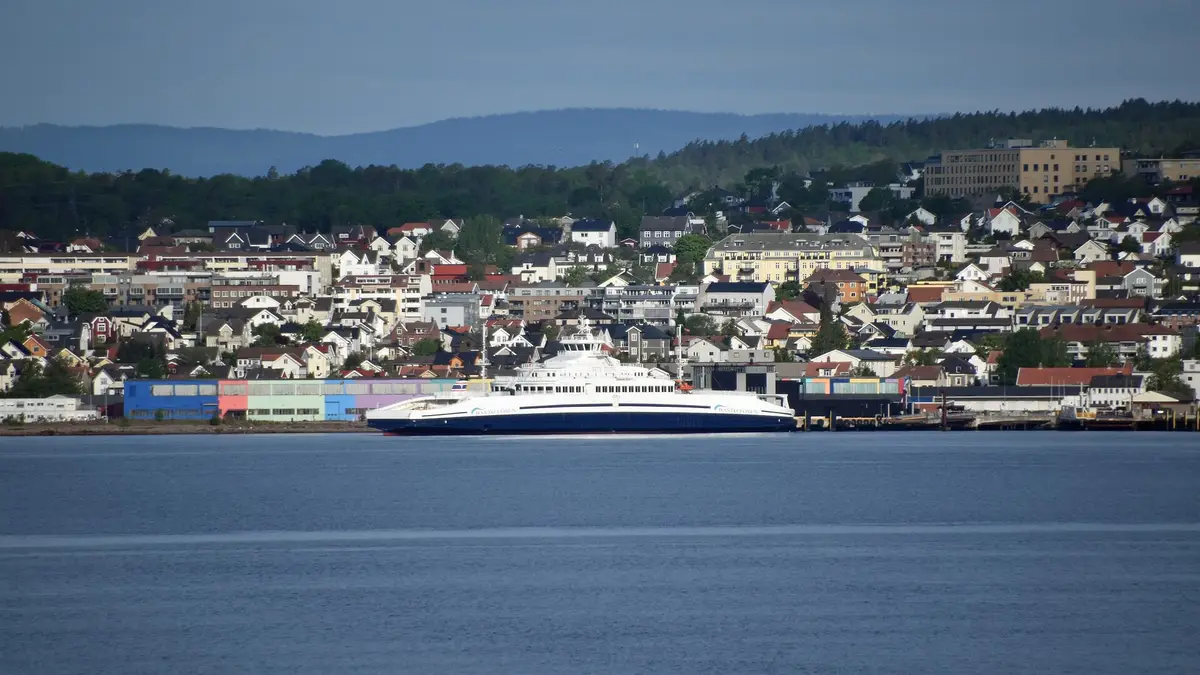
Norway is one of the countries with the most electric ferries because its grid runs almost entirely on hydropower, which makes every kWh charged on board clean and cheap. The same pattern shows up on land with buses: in Santiago, the RED electric fleet grew so much that sales of new buses fell in 2026, as explained in the drop in new bus sales.
The next largest electric ship in the world
The China Zorrilla's record may not last long. Danish ferry company Molslinjen ordered three 129-metre electric ferries from Incat, each with a 45 MWh battery, for the Kattegat routes between Aarhus, Ebeltoft and Odden, according to Riviera. They will carry up to 1,483 passengers and 500 cars, and will charge at 58 MW for 30 minutes at each port.
| Project | Owner | Length | Battery | Planned entry into service |
|---|---|---|---|---|
| Incat Hull 102 | Molslinjen (Denmark) | 129 m | 45 MWh | End of 2027 |
| Incat Hull 103 | Molslinjen (Denmark) | 129 m | 45 MWh | 2028 |
| Third Incat ferry | Molslinjen (Denmark) | 129 m | 45 MWh | 2029 |
Source: Riviera Maritime Media and Molslinjen. Dates are those reported by the operator and may change. Molslinjen puts the cost of the three ships and the charging infrastructure at DKK 3.5 billion, about US$546 million.
Chile and electric ships
No large electric ferry operates in Chile. The country's largest battery vessel is the tugboat Trapananda, owned by SAAM in partnership with state oil company Enap, presented in July 2025 as the first electric tugboat in Latin America, according to Reporte Minero. It is 25 metres long, carries a 3,616 kWh battery and has more than 70 tonnes of bollard pull. It was built at the Sanmar shipyard in Turkey to operate in Puerto Chacabuco, in the Aysén Region.
The Trapananda's battery is less than a tenth of the China Zorrilla's, but it is comparable to the European ferries that held the record in 2018 and 2019. In southern Chile, short, high-frequency crossings such as those to Chiloé or along the Aysén channels have a profile similar to the Danish and Norwegian routes, although they still run on diesel today.
The stakes are not small: every litre of diesel a ship stops burning reduces dependence on imported fuels, whose global demand the International Energy Agency expects to fall, as explained in the drop in global oil demand.
Does your company work in shipping, electric mobility or energy storage? Reach Energía Futura's readers.
See advertising optionsFrequently asked questions
What is the largest electric ship in the world?
Buquebus' China Zorrilla: a 130-metre catamaran with more than 40 MWh of batteries, 2,100 passengers and 225 vehicles, in service between Buenos Aires and Colonia since October 2026.
Which ship has the biggest battery?
The Chinese container ship Green Water 01, operated by COSCO Shipping, declares 50 MWh in swappable batteries, expandable to 80 MWh. It is shorter than the China Zorrilla and carries no passengers.
How long does the China Zorrilla take to charge?
Buquebus has not published an official charging time. The ship recharges in port between crossings of about 90 minutes; press reports on charger power vary, so they are not included here.
What is the longest electric ferry?
Norway's Bastø Electric, at 139.2 metres. It has operated between Moss and Horten since 2021 with a 4.3 MWh battery.
Are there electric ships in Chile?
Yes, but small ones. The largest is the tugboat Trapananda, owned by SAAM and Enap, with a 3,616 kWh battery and a length of 25 metres, assigned to Puerto Chacabuco.
How to cite this data
Energía Futura (2026). The largest electric ship in the world 2026: ranking of the biggest battery-powered ships. With data from Incat, Buquebus, Shippax, COSCO Shipping, China Three Gorges, Siemens Energy, ABB, Molslinjen and SAAM, accessed on 26 October 2026. Available at https://energiafutura.cl/en/news/the-largest-electric-ship-in-the-world-2026-ranking-of-the-biggest-battery-ships. The cover chart may be reproduced crediting Energía Futura and linking to this page.